

Savings Priority
This is a high-level priority list of what a saver/investor might do with that next dollar of income. Every family has a unique situation, so some of this might not apply to you or there may be some different priorities. However, this is a good starting point for a more detailed discussion.
EMERGENCY CASH Have cash available for emergencies in a readily available fund. Depending upon employment situations, consider having 3-6 months of fixed expenses readily available.
401(k) SAVINGS (up to match) Presuming the company you work for has a retirement plan, fund this first to the percentage of income that the company will provide the maximum match. For example, if the company matches 50% up to a 6% contribution, 9% total is contributed while you only put in 6% of your own money.
HEALTH SAVINGS ACCOUNT If you have a qualifying high-deductible health plan, you may save in a health savings account (HSA). Money saved in an HSA is pre-tax, money earned is tax-sheltered, and money spent on qualified health expenses remains un-taxed. If you can pay for medical costs out-of-pocket, that will allow your contributions to this tax-advantaged account to grow.
ROTH IRA Fund a Roth IRA for both spouses (income restrictions apply). Before adding additional money as number 2 above, to the 401k, consider maximizing the Roth contribution. The real beauty of this fund is that all assets are NOT TAXABLE when withdrawn in retirement.
SPECIAL GOALS Should you have a goal, for example, to fund some or all of your children’s education, consider one, or several, of the following: Education Savings Account, 529 plan, custodial account.
401(k) OR NON-QUALIFIED ACCT Save more in your 401(k), or depending on your situation, build up a healthy non-qualified account. Your NQ account is completely liquid, and may be a good “tax diversification” move.
CREATE YOUR LEGACY Should you be wildly successful in your NQ account, there are charitable accounts that can be opened and funded (important tax benefits with this) or give some to your children so it is taxed at their tax bracket (if they are under 18 years old, there are some tax issues to worry about, consult your advisor).
The minimum annual savings amount depends, but 15% of gross income is about the minimum; if you’re a late starter, it will take more. The objective is not to worship the acquisition of money, but to use it to achieve goals, enjoy it and benefit from it.
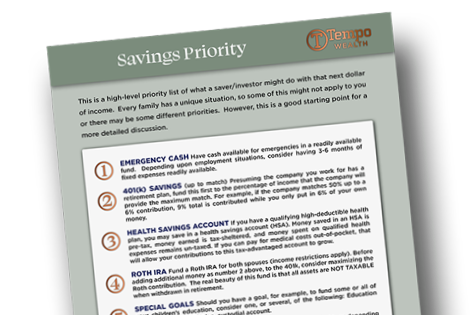
Savings Priority Guide
Download the Tempo Wealth Savings Priority Guide and share with others.
